
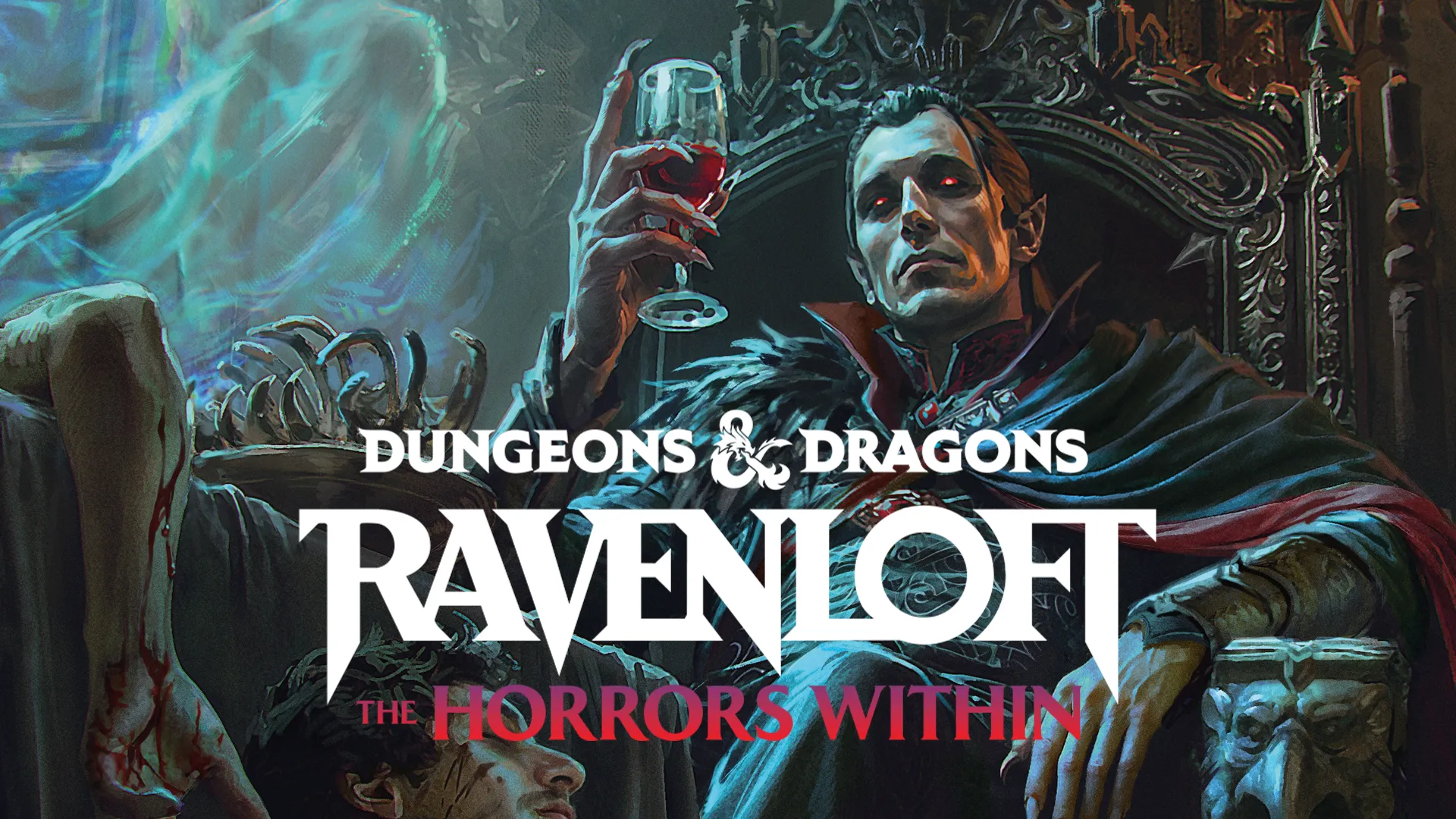
Ravenloft: The Horrors Within — what's actually new, and what WotC is asking you to trust

Ravenloft has never struggled with atmosphere. It has fog, cursed castles, tragic villains, and enough gothic misery to keep a vampire emotionally occupied for centuries. But with Ravenloft: The Horrors Within, the real question is whether Wizards of the Coast can finally make the Domains of Dread easier to run at the table.
Ravenloft does not need more fog.
It has fog. It has had fog for decades. Fog in the valleys, fog in the streets, fog curling around castle walls while someone pale and emotionally unavailable stares out of a window. Ravenloft has never struggled with atmosphere.
What it has sometimes struggled with is structure.
That is the real question hanging over Ravenloft: The Horrors Within, Wizards of the Coast’s 2026 return to the Domains of Dread. Not whether Ravenloft is still cool. It is. Not whether gothic horror still works in Dungeons & Dragons. It can. Not even whether Strahd is lurking somewhere in the background, silently judging the furniture. He probably is.
The real question is whether this book can make Ravenloft easier to run.
Because that has always been the tension at the heart of the setting. Ravenloft is one of D&D’s most evocative worlds, full of cursed realms, tragic monsters, doomed nobles, sinister bargains, haunted villages, and villains who could all benefit from therapy but have chosen architecture instead. It is brilliant material. But brilliant material is not the same as a playable campaign.
Sooner or later, a Dungeon Master has to stop admiring the Mists and ask a much less romantic question:
What actually happens at the table tonight?
That is where Ravenloft’s recent history becomes useful. Curse of Strahd gave DMs a campaign. Van Richten’s Guide to Ravenloft gave them a toolkit. The Horrors Within now has to prove it can do both.
Why Curse of Strahd still haunts every Ravenloft release
There is a reason Curse of Strahd is still treated as one of the great official D&D adventures.
It is not just because Strahd is famous. D&D has plenty of famous villains, many of whom spend most of their published adventures waiting patiently in final rooms like overqualified furniture. Strahd works because he is not just the final boss. He is the campaign’s weather system.
He watches the party. He tests them. He toys with them. He appears too early, too calmly, and far too well-dressed. Even when he is not present, Barovia feels shaped by him. The roads, the villages, the rumours, the allies, the fear, the history, all of it bends back towards the vampire in the castle.
That is why Curse of Strahd has endured. It gives DMs a focused sandbox with a clear central villain, a strong tone, memorable locations, and enough structure to survive players wandering off in the wrong direction. Barovia feels open, but not endless. Oppressive, but not shapeless. Cruel, but not random.
That does not mean it is easy to run.
Many DMs will tell you that Curse of Strahd is excellent, but demanding. It needs preparation. It needs careful tone management. It needs players who actually want gothic horror, rather than heroic fantasy in a Halloween cloak. It also benefits enormously from community support, fan revisions, extra notes, and a DM willing to keep Strahd active without turning him into a smug cutscene machine.
But even with those rough edges, Curse of Strahd has one enormous strength:
It knows what it is at the table.
That is the shadow every new Ravenloft book has to stand in. Not because every Ravenloft release should simply be Curse of Strahd again. Barovia has had enough visitors. Someone check on the local economy. But because Curse of Strahd proved that Ravenloft works best when its atmosphere is attached to playable pressure.
The fog matters because something is moving inside it.
 Wizards of the Coast / Bastien Grivet
Van Richten’s Guide was inspiring, but not always enough
Then came Van Richten’s Guide to Ravenloft, and its reputation is more complicated.
A lot of people like it, and for good reason. It expands Ravenloft beyond Barovia. It reminds newer players that the Domains of Dread are not just Strahd’s miserable wine country. It offers horror genres, safety tools, cursed character options, Dark Gifts, lineages like dhampir and reborn, and a broad tour through the many ways a D&D campaign can become unsettling.
As a horror toolkit, it has real value.
As a Ravenloft setting book, it is more divisive.
The common criticism is not that Van Richten’s Guide lacks ideas. It is full of ideas. The problem is that it often gives you ingredients rather than the meal. Here is a domain. Here is the mood. Here is the Darklord. Here is the horror genre. Here are some possibilities.
Now you, brave DM, go build the actual campaign.
For some groups, that is ideal. Plenty of DMs want exactly that kind of material: flexible, suggestive, open-ended. But it also means Van Richten’s Guide can be easier to read than to run. It inspires beautifully, but it does not always scaffold. It hands you a cursed painting, then quietly expects you to invent the museum, the murder, the night guard, and the reason the painting keeps bleeding at half past three.
That is the gap The Horrors Within needs to fill.
If it is just Van Richten’s Guide with more pages and a new hat, it may still be useful. If it is Van Richten’s Guide with enough adventure structure to actually run the Domains of Dread, then it becomes far more interesting.
The Horrors Within looks like WotC trying to bridge the gap
On paper, Ravenloft: The Horrors Within looks like a direct response to that problem.
The book includes 16 Domains of Dread, 17 Darklords, player-facing horror options, Dark Gifts, subclasses, species, backgrounds, monsters, maps, and support for both one-shot and longer-form play. The crucial detail is that each domain is being presented with a one-shot adventure and guidance for turning that domain into a longer campaign arc.
That matters.
Because “16 Domains of Dread” could mean a lot, or it could mean very little. A domain write-up can be three pages of atmosphere and a villain with cheekbones. Lovely, certainly, but not enough. A one-shot forces the book to answer practical questions.
What do the characters do here? What is the immediate conflict? How does the horror reveal itself? What does the Darklord want right now? What makes this domain different in play, not just in prose? How does the session end?
Those are not glamorous questions, but they are the questions that decide whether a setting gets used.
The campaign guidance matters too, because Ravenloft has always had a scale problem. Some domains are perfect for short, sharp horror stories. Others need room to breathe, rot, brood, and slowly ruin everyone’s week. If The Horrors Within can show DMs how to run both, it could become one of the most useful Ravenloft books of the 5e era.
The pitch is promising. The test is whether it actually does the work.
A Domain of Dread should be more than a spooky place
This is where The Horrors Within will either justify itself or vanish into the Mists wearing a very nice cover.
A good Domain of Dread should not feel like an ordinary fantasy region with worse weather. It should feel like a supernatural trap built around a wound. The domain exists because something terrible cannot resolve itself: a sin, a grief, a betrayal, an obsession, a punishment, a desire so twisted it has become geography.
That is what separates Ravenloft from a haunted forest or a creepy castle.
A Domain of Dread should have its own logic. Not necessarily only in the mechanical sense, though mechanics help. It needs story logic. Patterns. Pressures. Repetitions. Cruelties. Ironies. The land should behave according to its own nightmare rules.
A gothic domain might revolve around inheritance, bloodlines, obsession, and the terrible politeness of people who absolutely know where the bodies are buried.
A folk horror domain might make the village feel warm, welcoming, and entirely too unanimous.
A cosmic horror domain should not merely add tentacles. It should make knowledge feel like contamination.
A ghost story domain should understand repetition, unfinished business, and the dread of hearing the same song from the room you already checked.
A body horror domain should make the characters feel that their own flesh has become negotiable.
That is what The Horrors Within needs to capture. Not just “here is the horror genre,” but “here is how this horror genre behaves during play.”
If each domain comes with a playable engine, the book becomes genuinely valuable. If the domains mostly offer lore, mood, and a few encounter ideas, then DMs are back where they were before: standing in a beautifully cursed location, holding a notebook, wondering how to make session three feel different from session two but with more ravens.
Darklords need to do more than wait in the final room
The same is true of the Darklords.
A Darklord is not just a villain with a stat block. A Darklord is the emotional wound of the domain given a lair action.
That is the whole appeal.
The Darklord is trapped by their own nature. They are punished, but never quite changed. They hold power, but not freedom. They can hurt others, but cannot escape themselves. They have been handed eternal consequences and somehow still think the real problem is everyone else.
A Darklord who only appears at the end of an adventure is not really functioning as a Darklord. They are just a boss fight with a better costume department.
Strahd works because he is present long before the final confrontation. Even when he is not in the scene, Barovia makes him felt. His history shapes the land. His desires shape the plot. His attention changes the party’s behaviour. Players start making decisions based on what they think he might do.
That is what The Horrors Within needs to give DMs across its Darklords.
Not just a tragic backstory, a stat block, and a dramatic location, but practical guidance for making them active. How do they notice the party? What do they want from them? How do they tempt them? How do they punish them? What do they do if ignored? What do they do if challenged? How does the domain protect them? What mistake do they keep making?
If the book gives DMs that kind of material, the Darklords become campaign engines. If not, they risk becoming another gallery of compelling villains who still need the DM to do the hard work of making them matter.
And Ravenloft villains should never feel passive. They may be imprisoned, but they are not idle.
There is a difference between trapped and waiting.
Dark Gifts are where the horror reaches the character sheet
Warning
Spoiler note: This section discusses events and rules previews from Dungeon Masters episode 5.
The most interesting player-facing part of The Horrors Within may be the updated Dark Gifts, partly because Wizards has already let one of them escape into the wild.
That happened through Dungeon Masters, D&D’s new official actual play show, which is doing something more useful than simply advertising the book. It is previewing it in motion. The first major arc, Ashes of the Black Rose, ties directly into Ravenloft: The Horrors Within, following a fractured party trapped in Sithicus, a crumbling Domain of Dread ruled by Lord Soth. In other words, this is not just an actual play with gothic dressing. It is a live demonstration of the kind of Ravenloft campaign the new book wants people to run.
That matters, because horror rules are difficult to judge in isolation. A drawback that sounds clever in a book might become irritating at the table. A curse that looks harsh on paper might turn out to be exactly the kind of pressure the story needed. Actual play shows the emotional temperature of a mechanic. Do players laugh? Do they groan? Do they lean in? Do they start making worse decisions because the better ones have become frighteningly expensive?
That is useful information.
The clearest preview so far came through Lividity, the Scion of the Dead Three Rogue played by Alexander Ward. Lividity enters the party’s already delicate emotional ecosystem with the social grace of a thrown dagger. She has history with Eloin Emberleaf, joins the group despite that tension, and becomes part of their attempt to capture three banshees to placate Lord Soth.
Then the party tries to rest. And that is where the interesting bit happens. Ward reveals that Lividity has to roll for the drawback of her Dark Gift feat, Mist Walker. Suddenly, the Dark Gift is not just character flavour. It is not a spooky little ribbon tied around a useful ability. It is a rule reaching directly into one of D&D’s most important rhythms: the rest.
That is a big deal.
D&D characters are very used to power arriving in convenient parcels. A new level. A new spell. A subclass feature. A magic item. A sword that glows and almost certainly does not have opinions about your soul. Ravenloft should not work like that. In Ravenloft, power should feel like someone smiling from behind a locked door.
Dark Gifts have always been built around that idea. They represent a bargain, blessing, curse, inheritance, or contamination from the Dark Powers, the sinister forces behind Ravenloft’s Domains of Dread. In Curse of Strahd, Dark Gifts were tied to the Amber Temple and its amber sarcophagi, making them feel like dangerous bargains discovered in the depths of the campaign. Some of those gifts were wonderfully unpleasant. If your magical reward includes a requirement to eat bones or grave dirt to survive, the word “gift” is doing a heroic amount of public relations work.
Van Richten’s Guide to Ravenloft broadened Dark Gifts into more general character options, but their drawbacks often felt gentler. Some only triggered on a natural 1 or under narrow circumstances, which meant the curse could spend a lot of time politely waiting offstage while the benefit got on with being useful.
The Horrors Within appears to be changing that.
The preview from Dungeon Masters suggests Dark Gifts are now being treated as feat-based options, including Origin Feats that can be selected by 1st-level characters. That alone is significant. It means a character can begin a Ravenloft campaign already marked by the Mists, rather than waiting for a mid-campaign bargain or cursed temple moment, which changes the tone immediately.
A character with a Dark Gift is not just visiting Ravenloft. They are already compromised by it. They have already accepted, inherited, stolen, or been burdened with something that should make the rest of the party ask follow-up questions in worried voices.
Mist Walker is especially interesting because its drawback appears to make rest itself uncertain. According to the episode preview, Lividity has to make a DC 13 Constitution saving throw before resting, and on a failure the rest’s benefits can be negated. The exact published wording may differ, so this should be treated as a preview rather than final rules text. But even as a preview, the design intent is clear: the price of a Dark Gift is meant to come up during play.
A drawback attached to a rare natural 1 is flavour with occasional paperwork. A drawback that threatens rest, recovery, downtime, or safe haven is a campaign pressure point. It changes player behaviour. It makes the party think twice about where they sleep, when they push on, and whether this strange power is worth the cost.
The trick, of course, is balance. If Dark Gifts are too punishing, players will avoid them. If they are too gentle, they become accessories. The sweet spot is somewhere nastier and more interesting: powerful enough to tempt, costly enough to matter, and unpredictable enough to keep the table alert.
Lividity’s Mist Walker reveal suggests Wizards may be aiming closer to that sweet spot. Not necessarily back to the full grotesque punishment of Curse of Strahd’s Amber Temple bargains, but definitely beyond the more decorative drawbacks of Van Richten’s Guide.
And that makes Dark Gifts one of the best tests for The Horrors Within as a whole.
Does the book want Ravenloft to feel dangerous only in the story, or does it want that danger to reach the character sheet?
 Dungeon Masters / Wizards of the Coast
Dungeon Masters is a product demo, but an unusually useful one
That is why the Dungeon Masters rollout is more interesting than a normal actual play tie-in.
Official actual play can often feel like marketing with dice. Entertaining marketing, certainly. Expensive marketing, often. Marketing with excellent hair and suspiciously good microphones. But still marketing.
Dungeon Masters is doing something more direct. It is showing unreleased or upcoming Ravenloft material at the table, then connecting that show to D&D Beyond play material, including weekly ready-to-run encounters and quickplay maps inspired by the episodes.
That creates a surprisingly practical loop.
Watch the episode. See a monster, rule, Darklord, or tone choice in action. Then use the supporting material to run something adjacent at your own table. It is part preview, part tutorial, part sales funnel, and part public stress test. This work’s so well for horror in DnD.
Horror is not just a genre in D&D. It is a table agreement. Some groups want real consequences, slow corruption, dangerous bargains, and the creeping sense that every solution has left a stain. Other groups want spooky vibes, dramatic villains, and the occasional haunted doll, but would rather not have their long rests inspected by the Department of Gothic Consequences. Neither group is wrong, but they should not buy the same Ravenloft campaign expecting the same experience.
The Dungeon Masters episodes give DMs a free way to test that expectation. Watch how the table reacts when a Dark Gift interrupts a rest. Watch how the players respond to being trapped in Sithicus. Watch how Lord Soth functions as more than background lore. Watch whether the horror comes from monsters, mood, rules friction, party tension, or all of the above. That tells you something the product page cannot.
It also reveals WotC’s broader strategy for The Horrors Within. Wizards is not just saying, “Here is a horror book.” It is saying, “Here is how this horror book plays.”
That is a smart move, because Ravenloft’s biggest problem has never been making people interested. Ravenloft is already interesting. The harder job is convincing DMs that they can actually run it without becoming cartographer, horror theorist, villain psychologist, encounter designer, lighting technician, and part-time raven wrangler.
Dungeon Masters helps with that. Not perfectly. It is still a produced show, not your kitchen table with someone eating crisps directly into the microphone. But it does show rules and tone colliding in real time, which is exactly what horror needs.
If The Horrors Within is trying to bridge the gap between Curse of Strahd’s campaign structure and Van Richten’s Guide’s horror toolkit, then Dungeon Masters is the showroom floor.
A haunted showroom floor, admittedly.
But that is Ravenloft for you.
The preorder is also a platform opportunity
The other modern complication is digital support.
Preorders for The Horrors Within are not just about a physical book anymore. They come tangled with digital bonuses, maps, dice, encounter packs, VTT support, and platform-specific extras. That is useful, but it also highlights something Ravenloft has always benefited from: the right tools.
You are not just asking whether you want the book.
You are asking how you want to run it.
That matters a lot for Ravenloft. Horror thrives on presentation. Lighting, line of sight, map reveals, handouts, secret notes, NPC dossiers, atmospheric scenes, and carefully controlled information can all make a horror campaign smoother and more immersive. A good digital setup helps a DM reveal the right thing at the right moment without frantically opening six tabs and whispering, “Where did I put the corpse?”
That is one reason The Horrors Within feels like such a natural fit for a modern TTRPG platform. Ravenloft adventures are packed with mysteries, hidden information, recurring NPCs, and locations that evolve as the story unfolds. Having maps, encounters, notes, character information, and campaign management tools in one place can reduce prep and make it easier to focus on atmosphere rather than administration.
If your group already plays online or uses digital tools at the table, support for maps, tokens, encounters, and compendium content can make a meaningful difference. Nobody gets bonus virtue points for manually aligning castle walls at midnight.
Ultimately, the appeal of a book like The Horrors Within is not just reading it. It is running it. And if the new Ravenloft material delivers on its promise, it is exactly the kind of campaign many groups will want supported by the tools they already use to tell stories together.
A Ravenloft campaign is not a casual weekend away. It is a long stay in a cursed house where the walls remember your secrets. The easier it is to manage that house, the more time you can spend haunting your players.
So, is The Horrors Within actually new?
Yes, but the more important answer is that it may be new in the way Ravenloft needs.
The least interesting version of this book would be a bigger Van Richten’s Guide. More domains, more villains, more horror flavours, more player options, more fog. Useful, maybe. Attractive, probably. Transformative, not necessarily.
The more interesting version is a book that learns from both of its predecessors. From Curse of Strahd, it should take focus, pressure, active villains, and campaign shape. From Van Richten’s Guide, it should keep breadth, genre variety, flexible tools, and player-facing horror options.
Then it needs to add the missing piece: runnability.
That means one-shots that actually work, campaign guidance that genuinely helps, Darklords who do things, domains with playable logic, and Dark Gifts with meaningful costs. It means maps and encounters that reduce prep rather than simply decorate the product page. Ultimately, that is the standard The Horrors Within should be judged against.
Not whether it is pretty. It will be pretty.
Not whether it has lore. It will have lore.
Not whether Ravenloft is still beloved. It is.
The real question is whether a DM can open the book and run a memorable horror session without having to rebuild the engine in the garage first.
 Wizards of the Coast / Pam Wishbow
Should you preorder Ravenloft: The Horrors Within?
If you already know you want to run Ravenloft this year, the book looks like a strong bet. It has the right ingredients: multiple domains, Darklords, adventures, maps, monsters, Dark Gifts, and support for different lengths of play.
If you are more cautious, it is worth waiting for reviews that answer practical questions rather than aesthetic ones. Do not ask only whether the writing is good, because Ravenloft writing is usually good. Instead, ask whether the one-shots are actually runnable, whether each domain feels different in play, and whether the Darklords act throughout the adventure rather than waiting politely for initiative.
You should also look at how the Dark Gifts function at the table and whether the campaign guidance genuinely saves prep time. Most importantly, ask whether the book understands horror as a play experience rather than simply a genre label. Those answers will tell you far more about the book’s value than whether it contains another excellent painting of a haunted figure looking sad near architecture.
Although, to be clear, I do want that painting.
The verdict before release
The Horrors Within is promising because it appears to understand the problem.
Ravenloft has never lacked atmosphere. It has never lacked villains, mood, tragic backstories, cursed castles, sinister bargains, or birds with suspicious timing. What it has sometimes lacked is a clear bridge between inspiration and play.
Curse of Strahd built that bridge by focusing everything on Barovia and Strahd. Van Richten’s Guide widened the world, but often left DMs to build their own roads through it. The Horrors Within now has the chance to do something genuinely useful: make Ravenloft modular, varied, and runnable without losing the pressure that makes it special.
That is a difficult job, but if it succeeds, this could be more than another return to a beloved setting. It could be the Ravenloft book that finally lets the Domains of Dread function as more than beautiful nightmares in a hardback. Instead of asking DMs to become cartographers, horror theorists, villain psychologists, encounter designers, lighting technicians, and part-time raven wranglers before session one, it could provide a framework that gets them to the table faster.
And that, really, is the promise.
Not more fog.
Better ways to use it.
Tip
If you’re planning to disappear into the Mists for a few months, PostRoll can help keep your campaign notes, scenes, NPCs, maps, and table prep from vanishing with you. Sign up here.


